
2026-04-09 / UCAC4 547-018186 / (45) Eugenia
| # | OBS | Observer | Occ | Meth. | Instr. | CC | TSRC | UT1 | UT2 | UT3 | UT4 | UT2E | UT3E | Dur. | Chrd |
|---|---|---|---|---|---|---|---|---|---|---|---|---|---|---|---|
| 1 | show | Alberto Ossola | O+ | VID | M230 | CH | GPS | 19:44:08 | 19:45:54.54 | 19:46:02.22 | 19:47:18 | 0.400 | 0.240 | 7.68 | 211.2 |
| 2 | show | Andrea Manna, Simone Manna | O+ | VID | M200 | CH | GPS | 19:43:09 | 19:45:54.4 | 19:46:01.5 | 19:49:57 | 0.300 | 0.300 | 7.10 | 195.2 |
| 3 | show | Stefano Sposetti | O+ | VID | M280 | CH | GPS | 19:44:55 | 19:45:54.531 | 19:46:01.330 | 19:46:55 | 0.187 | 0.187 | 6.80 | 187.0 |
| 4 | show | Andreas Schweizer | O- | VID | M250 | CH | GPS | 19:45:24 | :: | :: | 19:46:24 |
4 observations found in db: sodis
Available (probably) matching predictions (click on the link to switch):| JPL#149 : 537caf90-33ba-11f1-6999-ba9827c7ad6e [db: asteroids] |
Using prediction 537caf90-33ba-11f1-6999-ba9827c7ad6e for map and profile fit
| Ellipse and circular profile fits to the timings (chords) |
|---|

|
Auto-Fit Result: Size = 213 x 132 km a',b' = 106.4, 66.2 km X0,Y0 = 404.1, 19.7 km Mean diameter = 168 km From 3 chords (VID) You can enter space separated chord numbers (example: 11 4 8) or a method like VIS to ignore all visual timings, or a time source like RAD and NTP (but not GPS). If the plot disappears, then there are less than 2 chords left (too much ignored, go back with browser). Check SiMDA for size and mass data. Check Johnston Archive for satellites. |
Sky projection (artificial light) for occ. time: 2026-04-09, 19:45 UT (JD = 2461140.323)
| DAMIT | Q | P (h) | λ, β | JD0 | JD-JD0 | φ0 | Version | Modified | Vol-equiv D | Cmnt |
|---|---|---|---|---|---|---|---|---|---|---|
| # 134 | None | 5.699 | 124°, -33° | 2.440381e6 | 20759.3 | 0.0° | None | 2013-09-06 | 172.0 +/- 16.0 km | 2013-09-03 |
| # 1812 | 4.0 | 5.699 | 127°, -35° | 2.440381e6 | 20759.3 | 0.0° | None | 2017-06-19 | 188.0 +/- 4.0 km | 2017-06-07 |
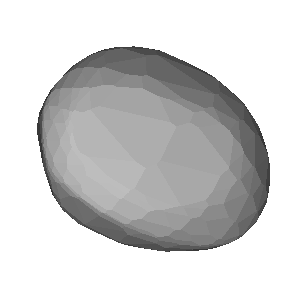
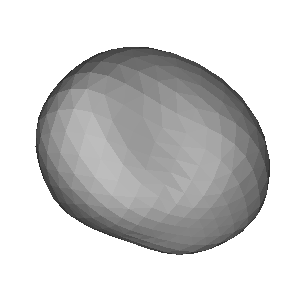
Image size: 300px. Transparent image background for copy & paste
| Map with groundtrack and observer stations |
|---|
| Event Details |
|---|
Occultation UUID [and DB] : 537caf90-33ba-11f1-6999-ba9827c7ad6e [asteroids] Occultation Date + Time : 2026-04-09 at 19:43:25 UT +/- 0.0 min [1] Object Designation : (45) Eugenia Orbit Class : MBA Star Designation : GDR3 3399225104481559296 Star Coordinates (ICRF) : RA = 05 43 03.5352, DE = +19 14 45.249 [2] Star Magnitudes : G = 13.81 mag, RP = 13.26 mag, BP = 14.18 mag Object Magnitude : V = 13.55 mag Estimated Magnitude Drop : 0.6 mag Estimated Max. Duration : 7.8 sec Object Mean Diameter : 214.6 km (src: astorb) Speed of the shadow : 27.5 km/s Elongation to Moon & Sun : 159° (sunlit = 54%), Sun = 66° Cross-track uncertainty : 0.7 mas = 1 km = 0.01 path-width (1-sig) RUWE and duplicate source : 1.0 mas, dup.src = 0 (0:false, 1:true) Ephemeris Reference : JPL#149 Note : FP:true [1] time t0 of closest geocentric approach c/a, [2] including proper motion until t0 |
| More Data and Informations |
|---|
(If error 404: link not valid which means no data available)
| Aladin Sky Atlas |
|---|
| Aladin Lite direct link (has Gaia overlay) |